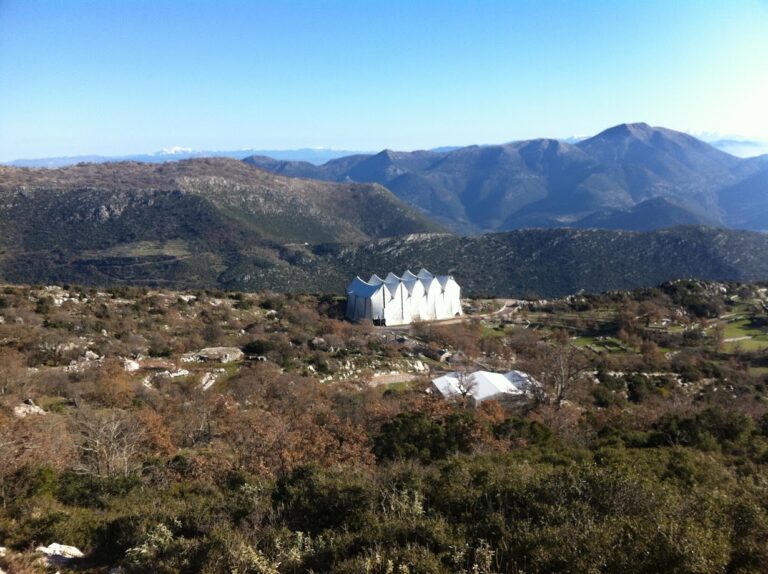
The celebrated Ionic frieze of the Temple of Apollo Epicurius, 31 m long and 0.63 m high, stood above a low Ionic architrave inside the main chamber of the cella. This interior Ionic entablature included twenty-three marble slabs carved with relief scenes of outstanding artistic quality.
Temple of Apollo Epicurius
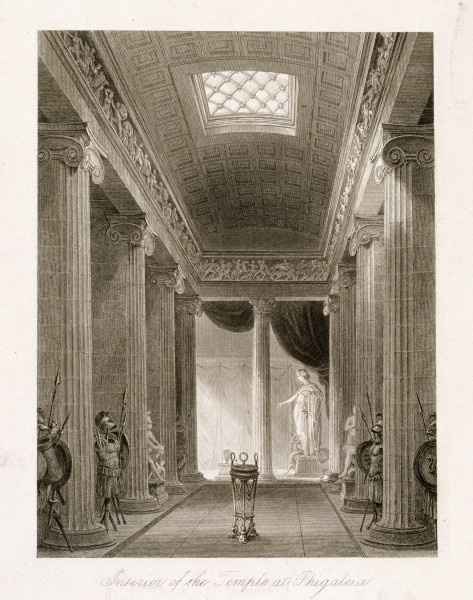
Reconstruction drawing of the cella
The drawing shows the Ionic colonnade and frieze, the single Corinthian column, and the cult statue of the god behind it in the adyton. Ch. R. Cockerell, The temples of Jupiter Panhellenius at Aegina and of Apollo Epicurius at Bassae near Phigaleia in Arcadia, London 1860.
Eleven slabs depict the Centauromachy, the battle between Lapiths and Centaurs, while the remaining twelve depict an Amazonomachy. The original position of each slab within the frieze is uncertain. Each presents a distinct episode within the unfolding narrative.
Scholars have attempted to attribute the frieze to a known sculptor, but no attribution has gained general acceptance. One proposed artist is Paionios of Mende in Chalkidike, who around 421 BC created the famous statue of Nike at Olympia and the acroteria of the Temple of Zeus.
Whoever their sculptor was, the reliefs from Phigaleia convey the intensity and action of the mythical battles with great skill. Rather than depicting the epidemic that struck Phigaleia, the compositions focus on the murderous frenzy of the Centaurs and the destructive invasion of the Amazons, two myths particularly familiar to the ancient Athenians.
Description
The Centauromachy was a favourite subject of Classical artists, including sculptors. Celebrated examples appear on the west pediment of the Temple of Zeus at Olympia, the south metopes of the Parthenon, and the frieze above the opisthodomos of the Temple of Hephaistos in Athens.
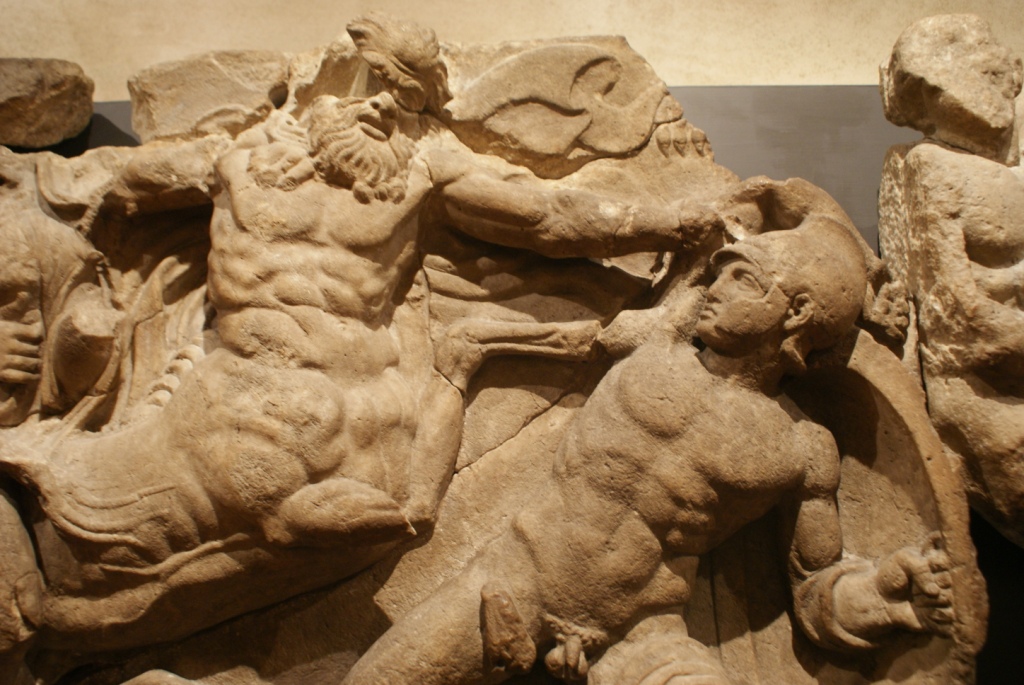
The reliefs show the Lapiths and Theseus confronting the Centaurs, creatures half human and half horse. According to myth, the Centaurs were guests at the wedding of King Peirithoos and Deidameia, or Hippodameia. After becoming drunk, they violated the rules of civilised conduct by attempting to abduct and rape the Lapith women. The sculptor skilfully contrasts the two groups: the Lapiths fight with weapons and strategy, while the Centaurs wield rocks and trees.
One of the most dramatic scenes depicts Kaineus, who could not be wounded. Unable to kill him with weapons, the Centaurs try to bury him beneath a huge rock as he struggles to free himself.
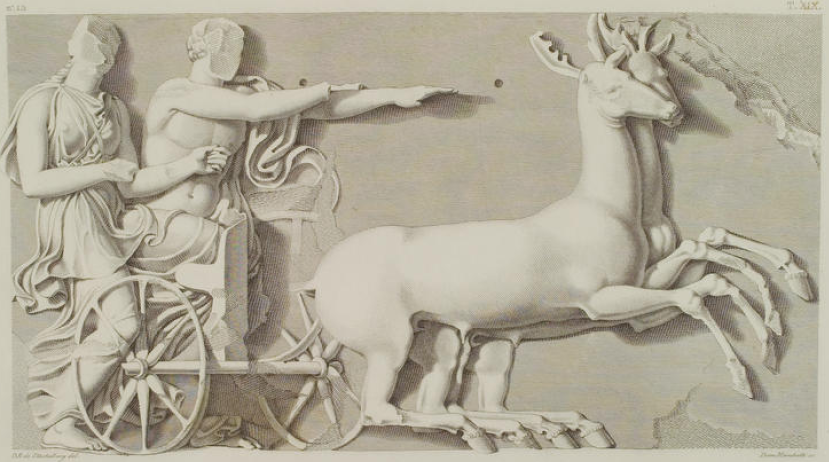
Apollo comes to the aid of the Lapiths. On one slab he appears as an archer riding a chariot, an image that evokes his help to the Phigaleians during the deadly epidemic of the Peloponnesian War.
Despite the Centaurs’ initial ferocity and strength, the Lapiths ultimately prevailed. Theseus, a friend of Peirithoos and a guest at the wedding, played an important role in their victory.
The Centauromachy is often interpreted as a conflict between civilisation and barbarism, reason and instinct. Within this ancient worldview, the human Lapiths represent order, while the Centaurs’ hybrid nature embodies chaos and lack of restraint. The Lapiths’ victory symbolises the triumph of civilisation over barbarism.
Ionic Frieze of the Temple of Apollo Epicurius
Centauromachy
Apollo comes to the aid of the Lapiths in a chariot drawn by two deer. Otto Magnus von Stackelberg, Der Apollotempel zu Bassae in Arcadien, Rome 1826.
The equally popular theme of the Amazonomachy occupies the other twelve slabs of the Ionic frieze at Bassae.
In Greek myth, the Amazons were a community of women warriors living in the Pontic region. When Theseus abducted their queen Antiope, they invaded Athens and besieged the Acropolis. The Amazonomachy recounts the battle of the young Athenians and their king Theseus against the Amazons at the Areopagus.
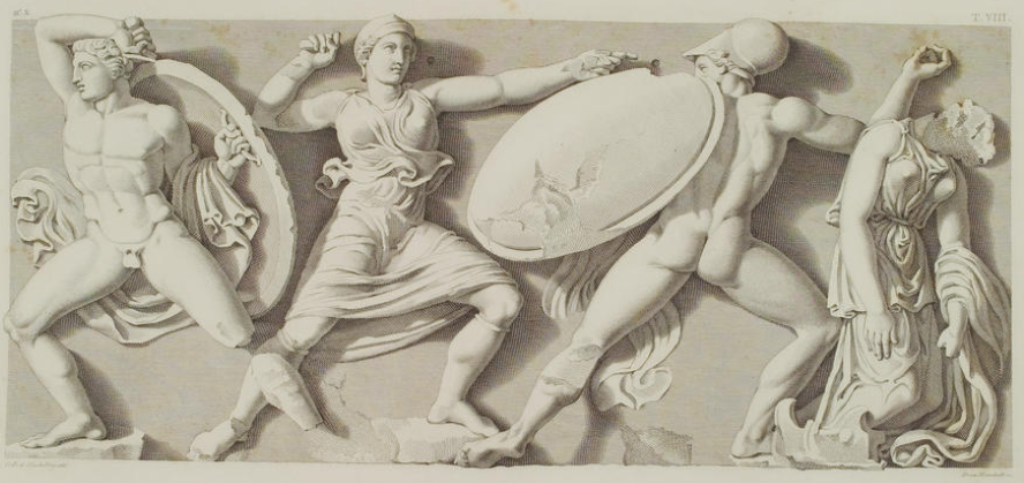
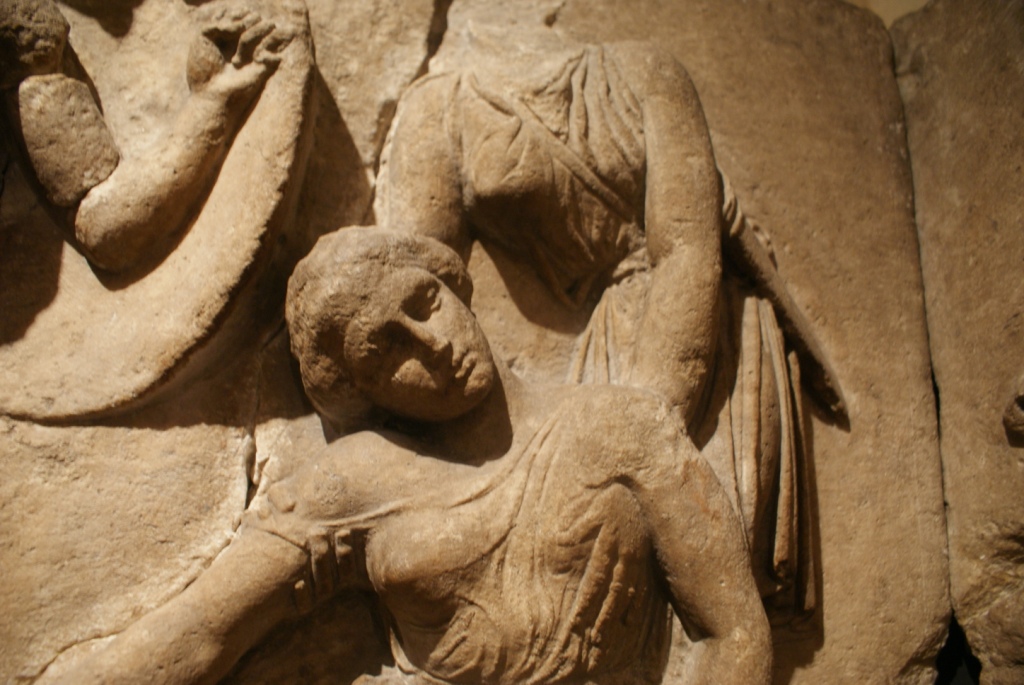
On the frieze, the men appear nude and the women clothed. The scenes display a rich variety of movement and energy. The combatants, generally arranged in pairs, express both the qualities and the contrasts attributed to the two groups.
The Athenian warriors, embodying the courage and strength of their city, overcome the warlike Amazons. The women nevertheless retain their beauty, vigour and determination.
Like the Centauromachy, the Amazonomachy is often interpreted as a conflict between civilisation and barbarism within the ancient Greek worldview. A society of women warriors in which men played a limited role challenged Greek social expectations. The victory of the Greek heroes therefore symbolised the reaffirmation of Greek social order and conventions.
Ionic Frieze of the Temple of Apollo Epicurius
Amazonomachy
An Amazonomachy scene on a slab of the Ionic frieze from inside the cella. One Amazon fights fiercely, while another falls, defeated by a Greek warrior.
Otto Magnus von Stackelberg, Der Apollotempel zu Bassae in Arcadien, Rome 1826.
The Fate of the Frieze and the Making of Plaster Casts
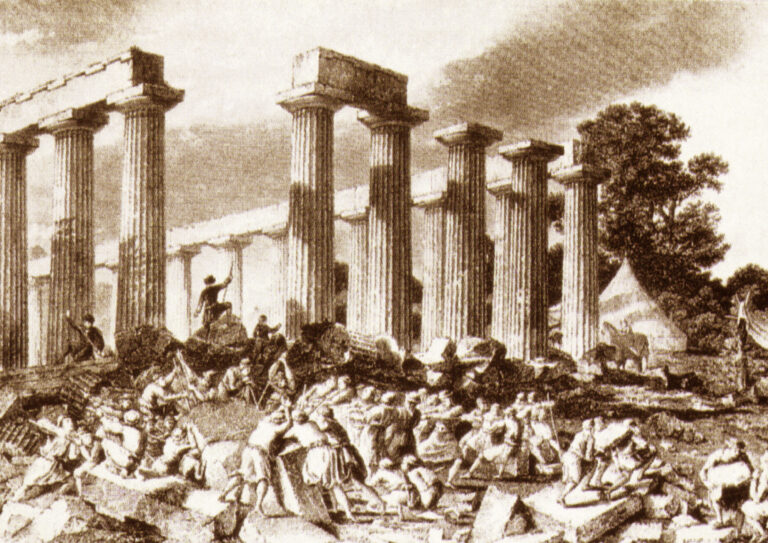
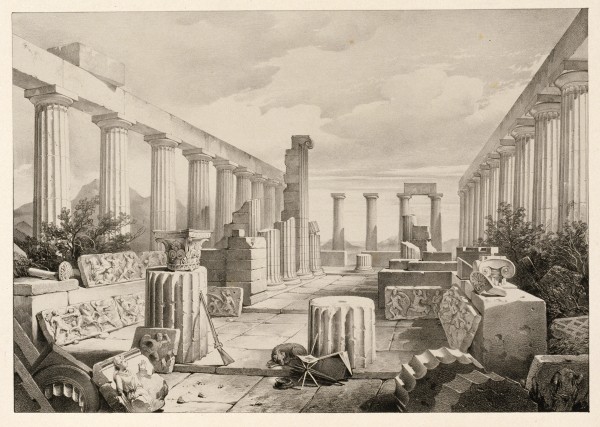
After their discovery and excavation by European investigators in the summer of 1812, the slabs of the Ionic frieze and other finds from the temple at Bassae were transported, after many difficulties, to Zakynthos, where they were housed for the next two years.
The discovery was first announced, together with a description of the collection, in a Zakynthos newspaper in September 1812. Each of the leaders of the expedition and owners of the collection received plaster casts of the complete frieze, which explains the presence of copies in several European collections. These details are recorded by Otto Magnus von Stackelberg, one of the principal participants.
The governments of Britain, France and Bavaria expressed interest in purchasing the collection, as they had done with the sculptures from the Temple of Aphaia. The successful bidder at auction was General Campbell, Governor of the Ionian Islands, acting for the British Prince Regent, the future George IV. The price was £19,000.
The sculptures reached London in the autumn of 1815 and were placed in the British Museum, where they are displayed near the galleries containing the Parthenon sculptures.
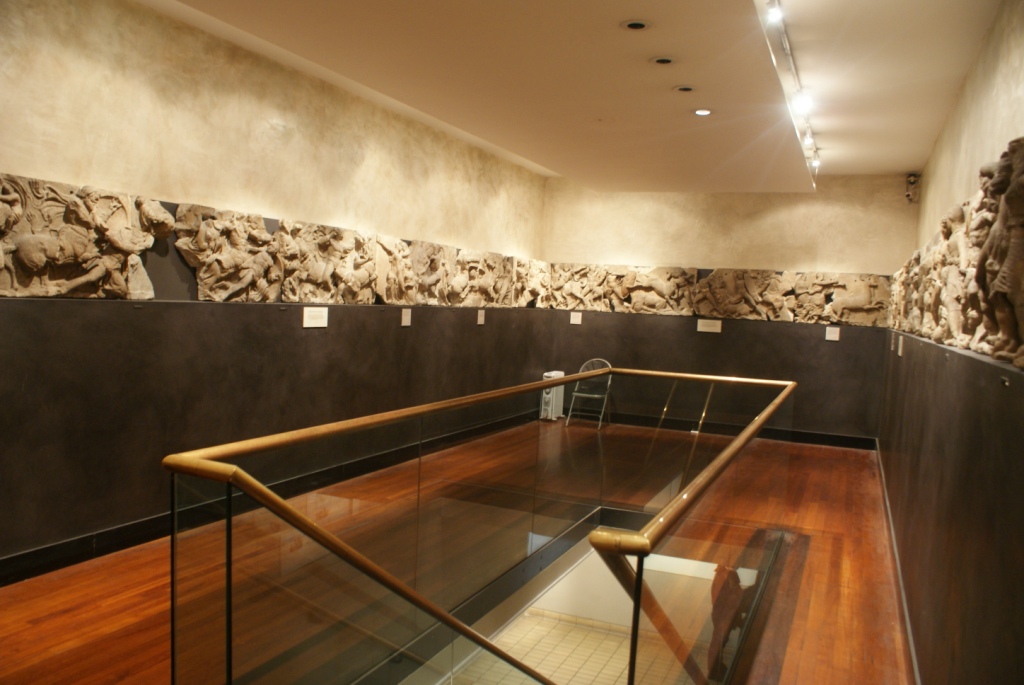
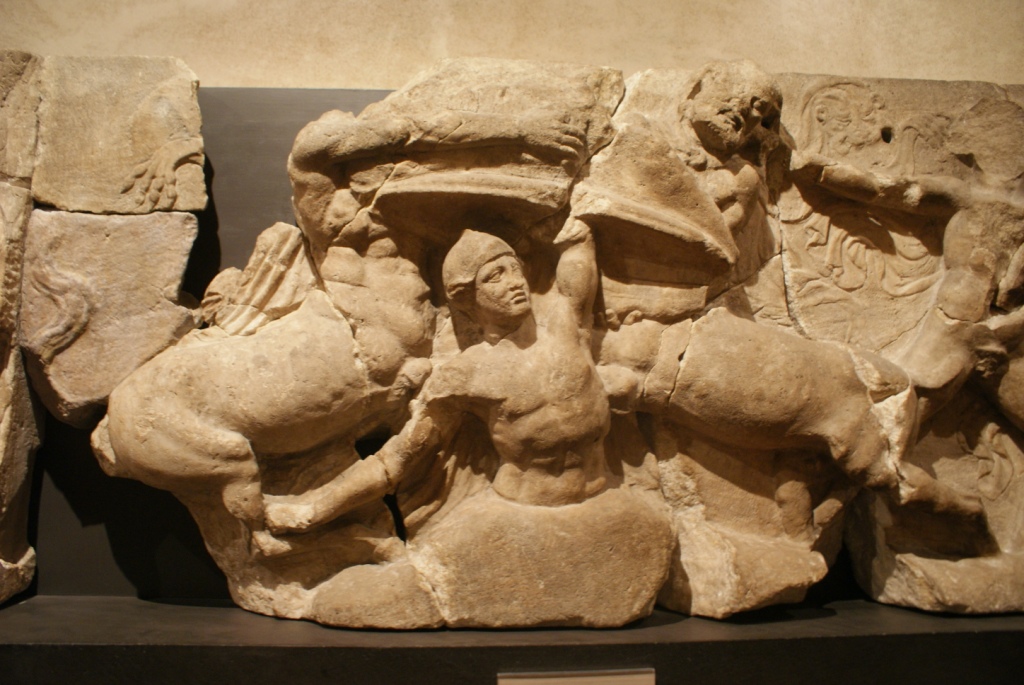


Following the international recognition of the independent Greek State by the London Protocol of 1830, the Archaeological Society at Athens sought plaster casts of the frieze. Responding to its request, the British Museum sent casts of the Acropolis sculptures in 1846 and of the Bassae frieze two years later. They were initially stored in a seventeenth-century Ottoman bath beside the Roman Agora in Athens.
In 1878, the plaster casts of the twenty-three slabs were transferred to the Temple of Hephaistos, which for a time served as an archaeological museum for the newly established Greek State.
Copies of the twenty-three slabs can be found in an interior corridor of the National Archaeological Museum in Athens and in the Nikolopouleios Municipal Library at Andritsaina.