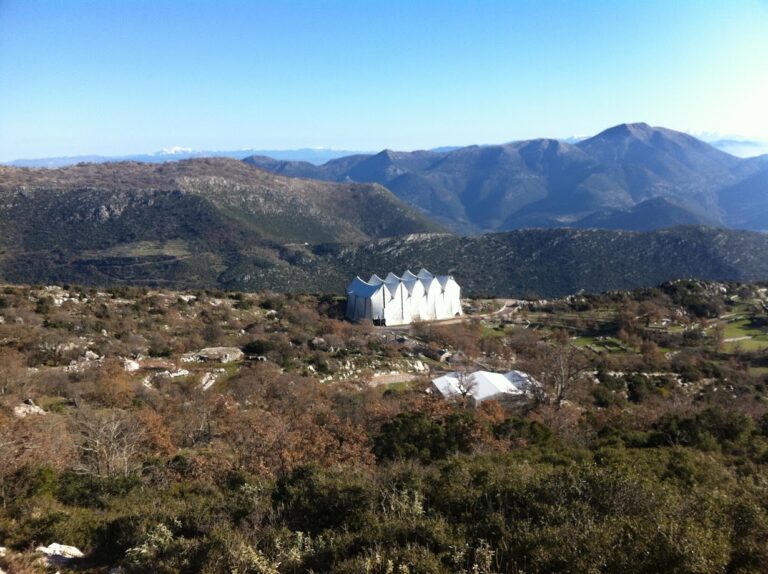
Introduction
The period from the mid-eighteenth to the mid-nineteenth century, following the maritime explorations of the fifteenth and sixteenth centuries, has been described as a second great age of discovery. Its intellectual background was shaped by the Renaissance and the Enlightenment.
These movements encouraged interest in, and admiration for, Classical civilisation and its achievements in Greece.
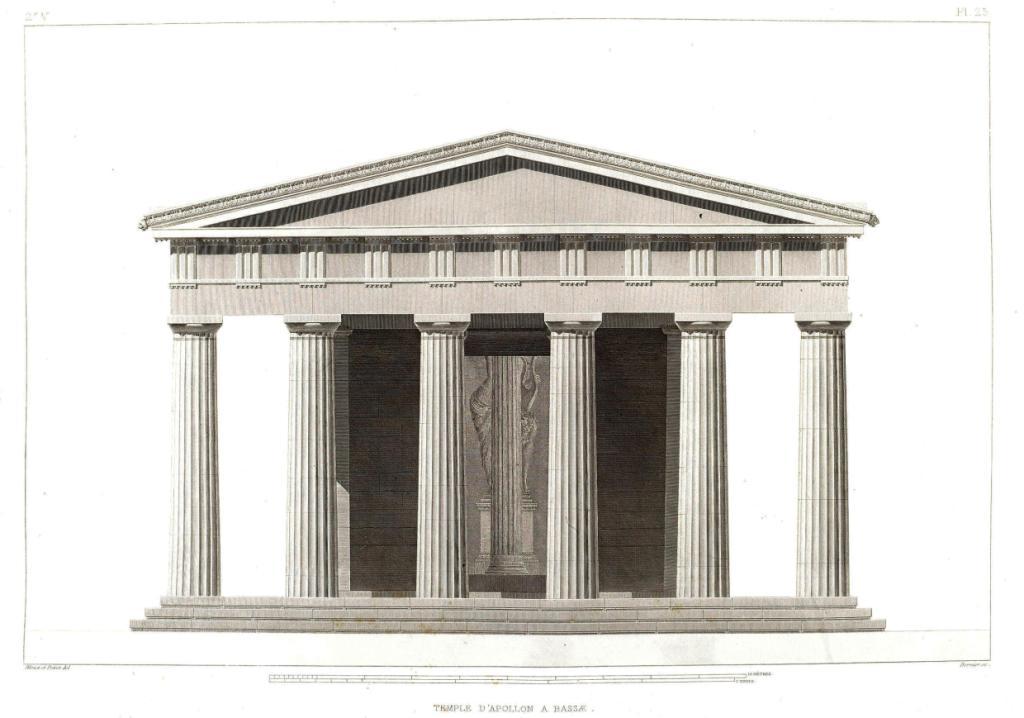
Inspired by this admiration, foreign travellers came to Greece in growing numbers. Leo von Klenze memorably described them as travelling with Pausanias in one hand and a spade in the other.
The historian Emmanouil I. Protopsaltis observed that the study of antiquity gradually became both an aristocratic pursuit and a profitable enterprise, for which Ottoman Greece offered favourable conditions.
From the late eighteenth century until the Greek War of Independence, European scholars competed to assemble collections of Greek art. This period was also marked by Lord Elgin’s systematic removal of sculpture from the Parthenon in the early nineteenth century.
The Antiquarian Explorers
Excavation at Bassae took place in the summer of 1812. It grew out of the activities of a circle of northern European architects, artists and antiquarians, including Carl Haller von Hallerstein, Jacob Linckh, Otto Magnus von Stackelberg and Peter Oluf Brøndsted.
These ambitious and knowledgeable investigators combined the study of ancient monuments with the acquisition and subsequent sale of antiquities.
Joined by the British architects C. R. Cockerell and John Foster, members of this circle investigated the Temple of Aphaia on Aegina in 1811. Its pedimental sculptures were sold to Crown Prince Ludwig of Bavaria in 1812.

Haller von Hallerstein, Linckh, Cockerell and Foster reached Bassae on 25 August 1811. The Ottoman governor of Phanari, whose jurisdiction included the temple, stopped their investigations and required them to obtain explicit permission from Veli Pasha, governor of the Peloponnese. They had already recognised not only the architectural importance of the monument but also the presence of valuable sculpture beneath the rubble inside the cella. A fox fleeing its den is said to have drawn their attention to the hidden reliefs.
Charles Robert Cockerell described the discovery in his volume on the temples of Aegina and Bassae, published in 1860:
During their first visit in 1811, a member of the party noticed a narrow opening among the fallen stones inside the cella. It was barely wide enough for his head and shoulders. His companions held his feet so that they could pull him out again. Beneath the rubble he found the recently abandoned fox’s den; clearing it aside revealed a Centaur and a Lapith locked in combat. (Paraphrase of Cockerell’s account.)
The expedition returned in June 1812, with participants including Stackelberg, Brøndsted and Thomas Legh. It had secured Veli Pasha’s permission in return for a substantial payment. The mediation of the Austrian consul in Athens, Georg Christian Gropius (1776–1845), also helped the work proceed.
For approximately two months, the expedition cleared the area around the temple and moved fallen stones from its interior to the immediate surroundings. Numerous local labourers, farmers and shepherds took part—up to 120 according to some modern accounts. Haller studied the building, while Haller, Foster and Cockerell produced drawings documenting the monument.
The Discoveries
The most important result was the recovery of the temple’s Ionic frieze from beneath the fallen masonry. Its twenty-three slabs depict the Centauromachy and Amazonomachy and survived largely intact.
The investigations also uncovered fragments of the sculpted Doric metopes from the pronaos and opisthodomos, Ionic capitals, the unique Corinthian capital, and four marble fragments from the adyton belonging to the extremities of a large acrolithic statue.
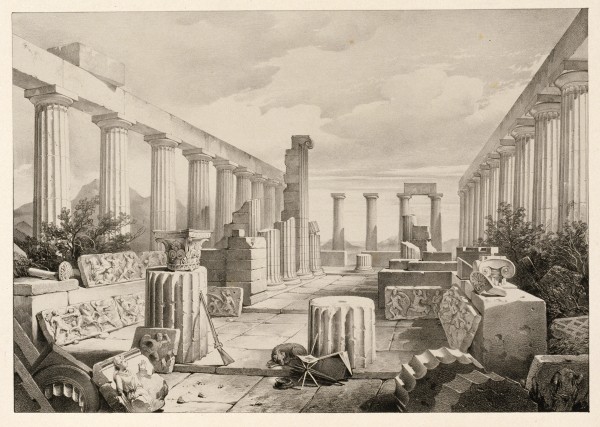
Veli Pasha relinquished his claim to the sculptures in return for payment. Once the excavations were complete, the temporary camp beside the temple was dismantled and the monument was left in isolation once more.
The Removal of the Frieze and Its Transfer to Britain
Transporting the sculptures over rough tracks with the means available at the time proved difficult and hazardous. They were taken to the Ionian coast near Kyparissia and then to Zakynthos. The collection was offered for sale in 1814 and entered the British Museum in 1815.
The Ionic frieze and the other surviving sculptural fragments from the Temple of Apollo Epicurius form another major ensemble of Classical sculpture displayed in London, alongside the Parthenon sculptures removed by Elgin.
The 1812 excavations were a turning point in the monument’s history. They brought new evidence to light and made the temple more widely known to scholars. They also profoundly altered its state of preservation. Architectural members and fragments of marble decoration that had survived beneath the rubble were exposed to weathering after excavation, and some material was later reused locally or burnt to produce lime.