The City Responsible for the Sanctuary
In antiquity, Phigaleia was one of the most powerful Arcadian cities. Its territory included the sanctuary and Temple of Apollo Epicurius, and it was also associated with the region of Triphylia. The city took its name from its mythical founder, Phigaleus.
Phigaleia’s territory extended northeast to Mount Kotilion, where the Temple of Apollo Epicurius stood, and southwest to Mount Elaion, the location of the sanctuary of Demeter Melaina, or Black Demeter.
Pausanias also records a collective tomb of the Oresthasians, who helped the Phigaleians drive out the Spartans after 659 BC. The foundation of the Archaic temple of Apollo was associated with gratitude for the god’s assistance in this victory: Epicurius means “helper”.

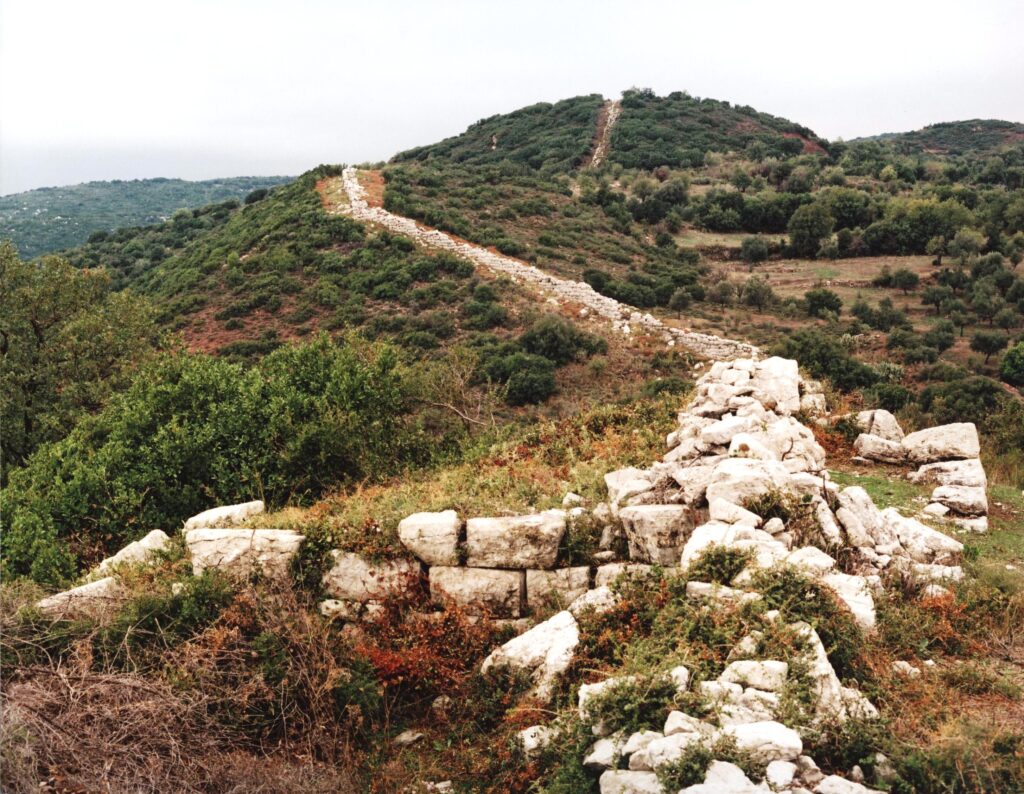
The city was enclosed by a strong defensive wall approximately 4 km long, with rectangular and circular towers. Substantial stretches survive in very good condition and to a considerable height.
Within the circuit are a fortified acropolis and monumental buildings.
The nearby River Neda played an important role in the city’s prosperity. Small vessels could navigate the river, while archaeological finds, including a Roman-period coin depicting it as a deity, attest to its significance for the city.
The river connected Phigaleia with the Ionian Sea and helped the development of trade. Agriculture and livestock farming were additional sources of wealth, while the region’s road network facilitated the movement of goods.
Pausanias (8.39–41) mentions sanctuaries of Artemis Soteira, Dionysos Akratophoros and Eurynome, as well as a gymnasium and an agora with statues of Hermes and the Olympic victor Arrhachion. A kouros found in the ancient agora, now displayed in the Museum of the History of the Olympic Games in Antiquity at Olympia, has been associated with Arrhachion.
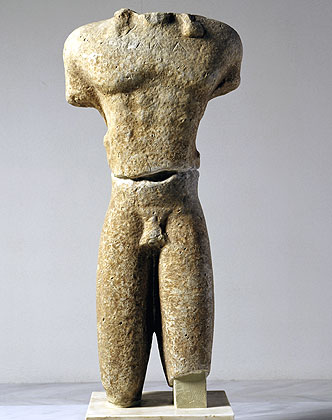
Arrhachion became famous in Olympic history because he died in a hold applied by his opponent while competing in 564 BC. Since his opponent had already conceded defeat, the Hellanodikai proclaimed Arrhachion the victor posthumously. Pausanias saw and described the athlete’s statue in the agora of his native Phigaleia.
The city’s coins also provide evidence for the worship of Hygieia, Asklepios, Aphrodite, and Neda or Tyche.

Excavation has uncovered an Early Hellenistic fountain whose spring still flows, and a cemetery west of the ancient agora. Its monumental tombs show similarities to those of ancient Alipheira and Messene.
The Temple of Athena and Zeus Soter is the most important excavated monument at Phigaleia. It stands on Kourdoumbouli hill at the southwest edge of the ancient agora. The rectangular building comprises a pronaos and cella and follows an east–west orientation. It was used from the fourth century BC into the Roman period and probably had an earlier Archaic phase.
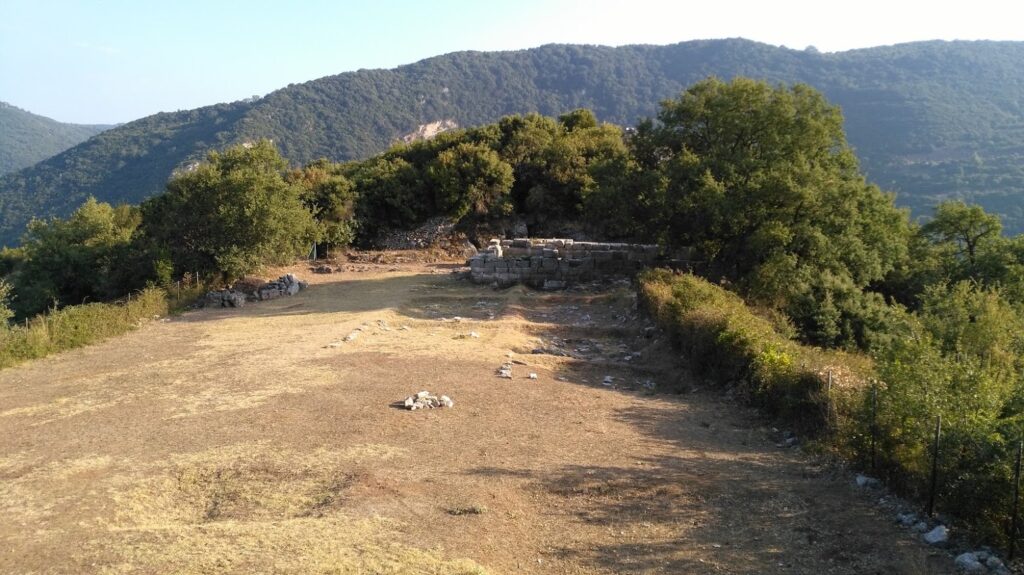
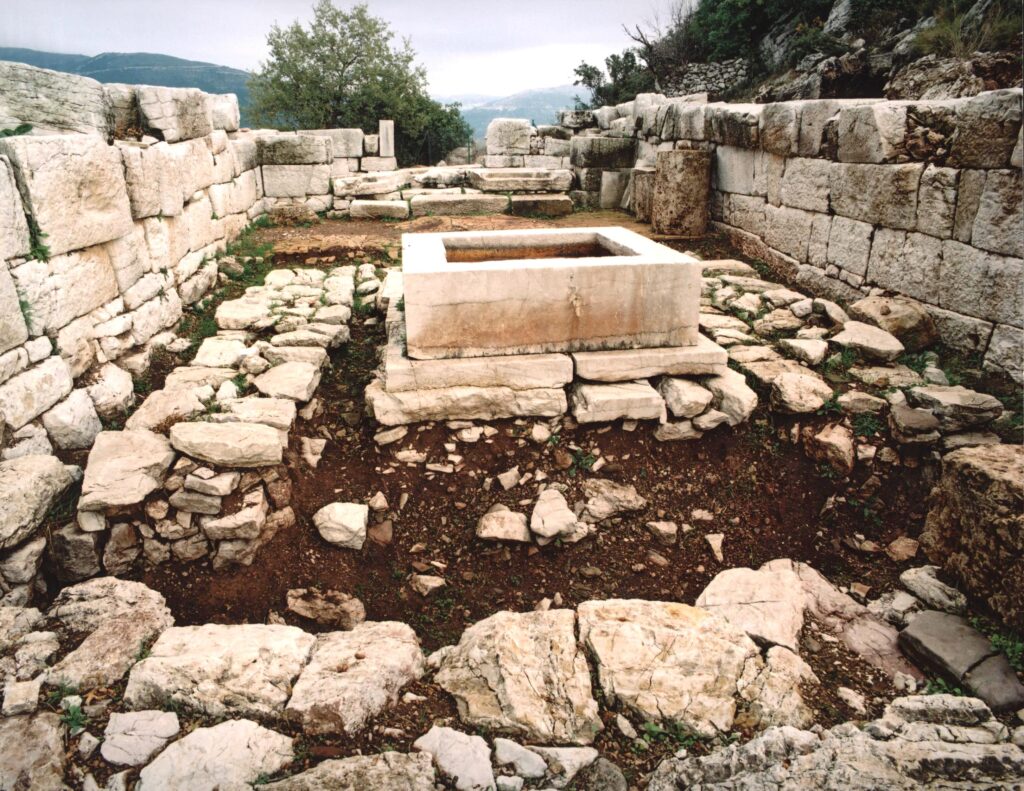
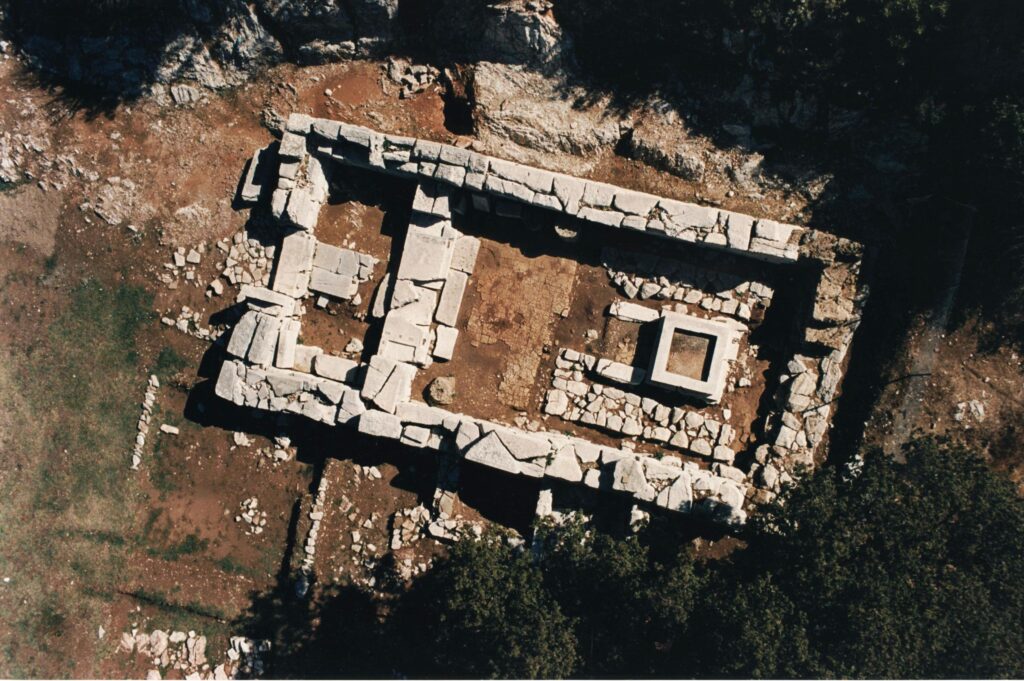
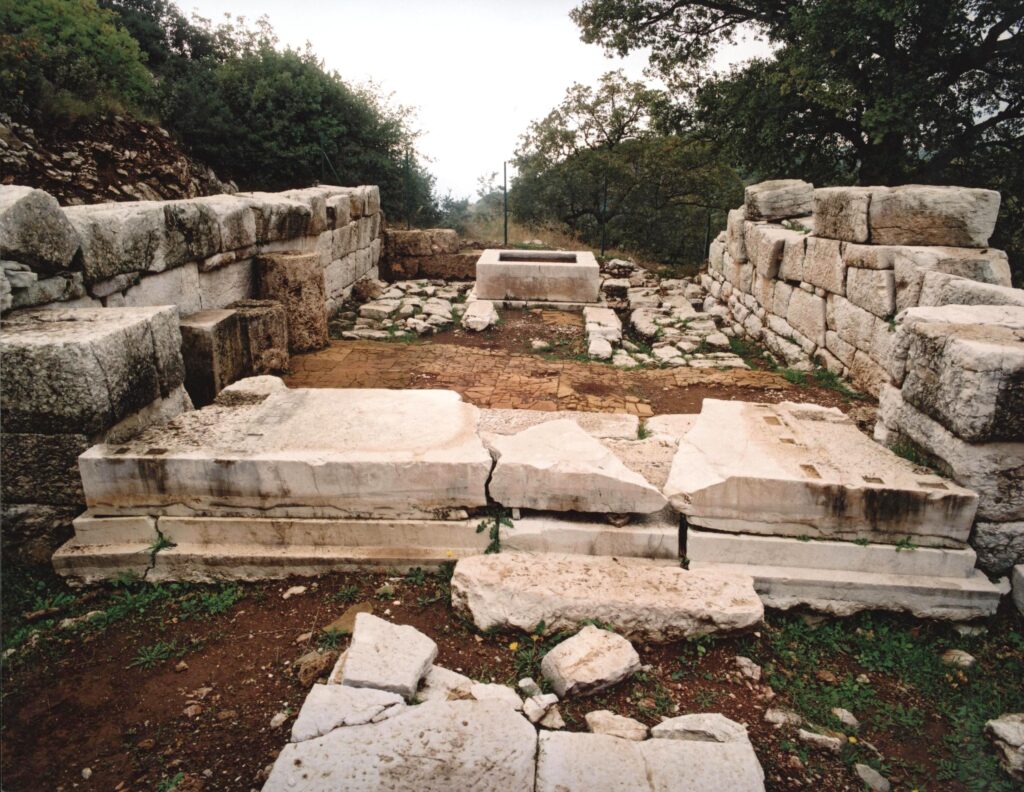
The identification of its deities rests on inscribed statue bases. Excavation showed that occupation of the hill began in prehistoric times. During the Byzantine or Frankish period, the temple appears to have been converted into a dwelling.
Built of large rectangular stone blocks in irregular isodomic masonry, the temple survives to a maximum height of three courses. A monolithic threshold connects the pronaos with the cella. A cubic stone base for the cult statue was found in place at the rear of the cella, with an offering table in front of it.
The altar probably stood on the terrace in front of the temple. A deep natural fissure was identified in the rock to its south, while remains of a Middle and Late Helladic settlement were uncovered to the north.
Numerous fragments of inscriptions were recovered inside the temple, showing that the sanctuary also played an important political role in the city.