Archaeological evidence indicates that the temple remained in use at least until the visit of Pausanias in the second century AD. His account is the only surviving description of the monument from antiquity. In the centuries that followed, human interventions and natural forces caused its deterioration and neglect. The temple faded from wider memory, although local residents and shepherds continued to know of its existence.
Some sixteen centuries passed between the visit of Pausanias and the Enlightenment, when European travellers brought the monument back to wider attention.
The region’s rich history, compelling myths and natural beauty, described by ancient writers, encouraged European travellers to visit and explore Bassae from the late eighteenth century onwards.
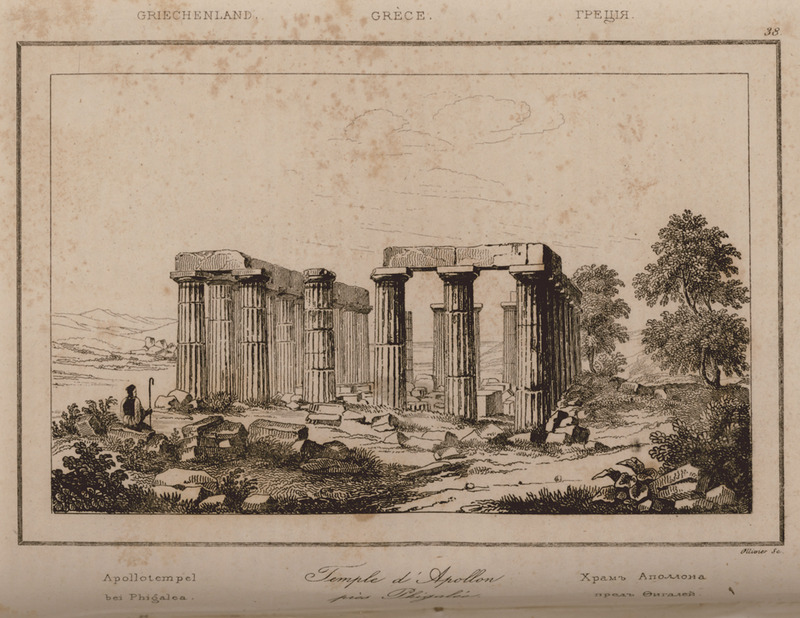
Voyage dans la Grèce
Temple of Apollo Epicurius
POUQUEVILLE, François-Charles-Hugues-Laurent. Grèce. Paris, Firmin Didot, MDCCCXXXV [1835].
The French architect Joachim Bocher encountered the monument while travelling in Arcadia in 1765. With almost all its columns still standing, he immediately identified it as the Temple of Apollo Epicurius described by Pausanias. The first published account appeared in 1776, however, in the work of the English scholar Richard Chandler, whom Bocher had informed about the monument. Bocher had returned to Bassae to study the temple but was killed by bandits active in the area.
The temple subsequently attracted European antiquarians, artists and scholars fascinated by the rugged beauty of its setting and its architecture. They studied, drew and painted it, recording observations about its form and architectural orders. Some visitors also took the opportunity to plunder it.
Among these visitors were the French draughtsman, antiquarian and vice-consul in Athens Louis Fauvel, who travelled to Bassae in 1787, and his compatriot François Ch. H. L. Pouqueville, a physician, diplomat, writer and philhellene. Pouqueville included Bassae in his widely read Voyage dans la Grèce (1820–1821).
The English architect Robert Smirke also drew the temple. The Irish writer, painter and traveller Edward Dodwell described his impressions and the monument’s state of preservation in A Classical and Topographical Tour through Greece (1819), an account of his travels in Greece.
Recalling his striking first view of the temple during his visit in 1806, Dodwell observed that the ancient Greeks chose the settings of their temples in part to surprise visitors and inspire awe as they approached the sanctuary.
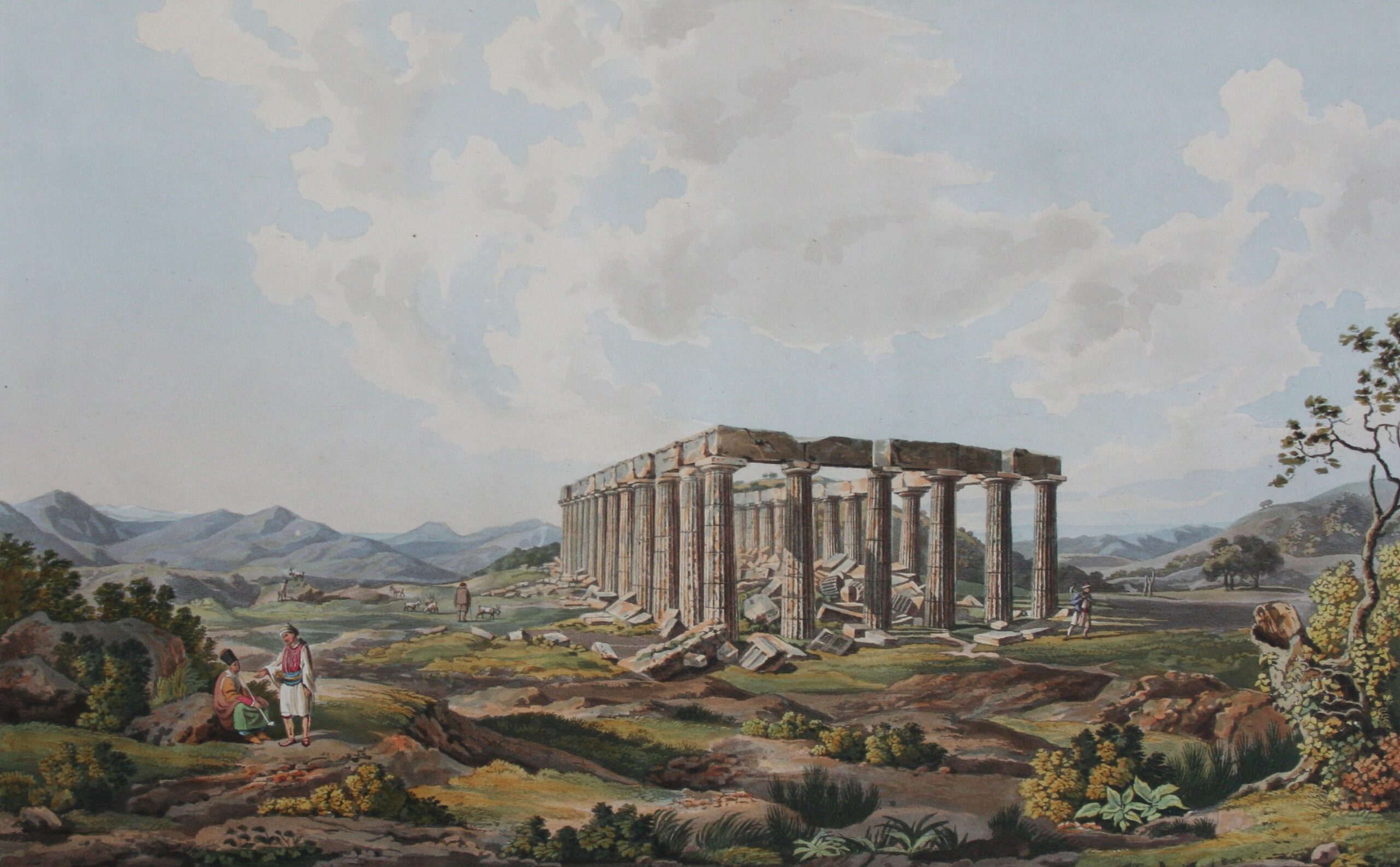
DODWELL, Edward
Temple of Apollo Epicurius
Views in Greece, from Drawings by Edward Dodwell Esq. F.S.A &c., London, Rodwell and Martin, 1819.
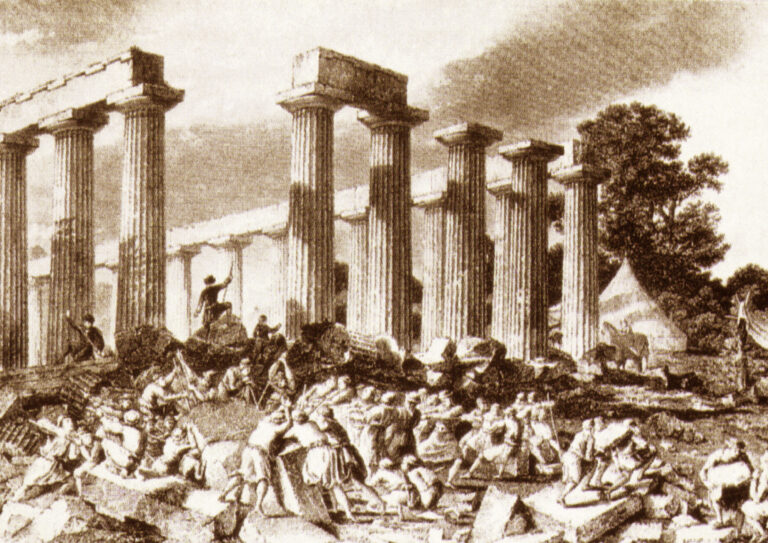
A decisive episode in the history of the monument was the expedition of European antiquarians who arrived at Bassae in the summer of 1811 to investigate it. Their work led both to important discoveries and to the removal and loss of elements essential to understanding the temple. This episode is discussed in a separate section of the website.
Many other scholars subsequently visited the Temple of Apollo Epicurius. Their studies, observations, drawings and paintings provide valuable evidence for its history. They include T. L. Donaldson, T. Abercromby Trant, Carl Rottmann, L. Ross, F. G. Welcker, F. C. Penrose and D. Lebouteux.
Modern researchers continue to consult this extensive body of architectural drawings, surveys, measurements and artistic depictions. It helps them reconstruct the history of the monument and supports its study and restoration with the greatest possible accuracy.